

Venezuela: US Removes Enriched Uranium from Obsolete Nuclear Reactor


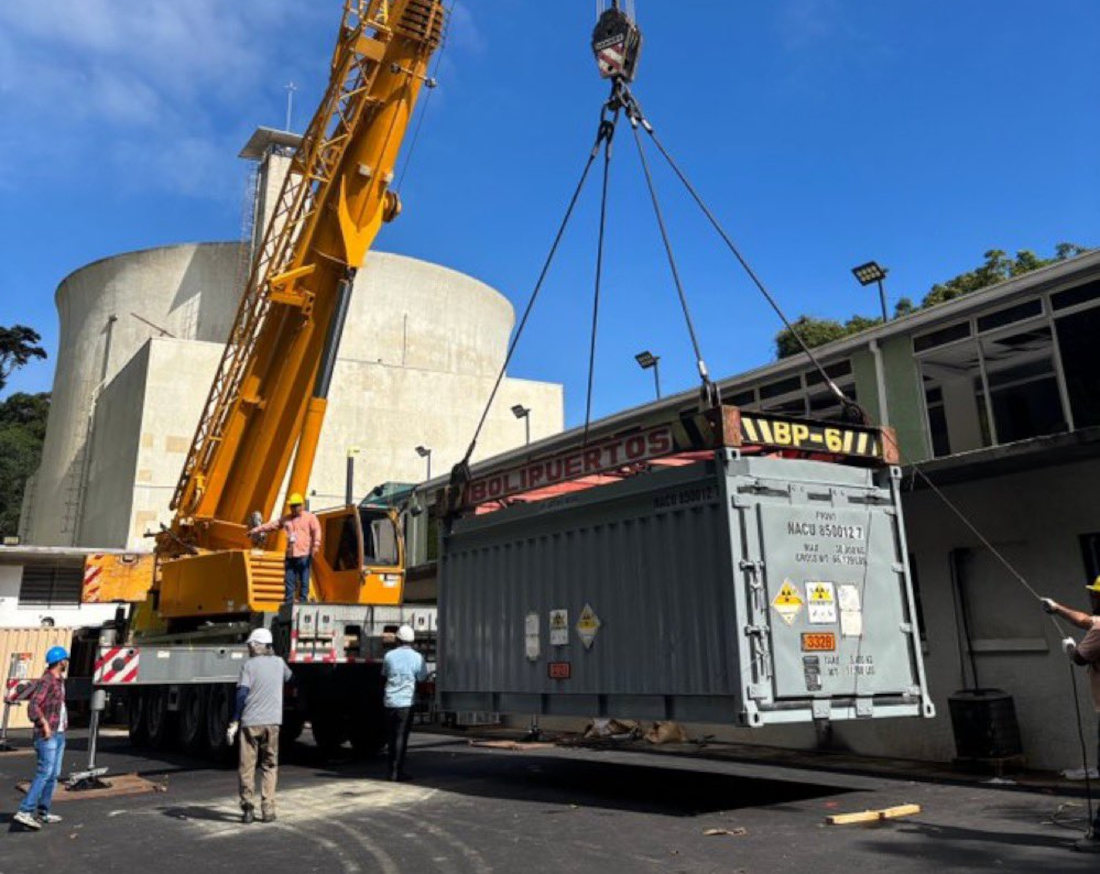
Mérida, May 12, 2026 (venezuelanalysis.com) – The US and Venezuelan governments, in coordination with the United Kingdom and the International Atomic Energy Agency (IAEA), completed the extraction and secure transfer of 13.5 kilograms of enriched uranium.
This radioactive material had been stored since 1991 following the decommissioning of a nuclear research reactor of the Venezuelan Institute for Scientific Research (IVIC) in Miranda state.
The operation to remove the uranium, enriched over 20 percent, was carried out in late April under strict security and IAEA oversight. The shipment was transported by land to the port of Puerto Cabello, and then by sea on a British vessel to the US Department of Energy’s Savannah River Site in South Carolina.
The Venezuelan government, led by Acting President Delcy Rodríguez, released a statement on Thursday, May 7, explaining that it had “repeatedly communicated to the IAEA the need to remove the disused sources and materials that remained in the country.”
The official statement emphasized that the January 3 US military attack, in which two US missiles struck approximately 50 meters from the reactor, had “objectively increased the risk level and urgency” of extracting the radioactive material. Caracas emphasized that the transfer was carried out in accordance with safety standards and international nuclear non-proliferation treaties.
The US Embassy in Venezuela described the operation as “a victory for the United States, Venezuela, and the world.” In a statement released on Friday, the diplomatic mission praised the “decisive leadership of President Donald Trump” and the work of US on-the-ground teams that “completed in months what would have normally taken years.”
According to the official US note, the recovered material will be used for research and the development of new technologies as part of what the Trump administration calls a “nuclear renaissance.”
While the statement did not detail specific uses, the dilution and processing of highly enriched uranium can provide inputs for medical isotope production, experimentation with next-generation reactors, and fuel development for small modular reactors (SMRs), which operate at enrichment levels up to 20%.
The State Department, through Assistant Secretary for Arms Control and Nonproliferation Christopher T. Yeaw, has stated that “working alongside our DOE/NNSA, UK, IAEA, and Venezuelan counterparts, we’ve demonstrated how effective partnerships can eliminate nuclear proliferation risks and enhance global nuclear security.”
For its part, the International Atomic Energy Agency confirmed that it provided “nuclear safety and security guidance, training, and technical expertise.” In a statement, the IAEA highlighted the risk of radioactive material “falling into the wrong hands,” while Director General Rafael Grossi praised “the professionalism of all the parties involved.”
The IAEA has provided details of the transfer of uranium enriched to just above 20 percent of the fissile isotope uranium-235 from the RV-1 reactor at IVIC, located 15 km southwest of Caracas. This level is regarded as the threshold for “highly enriched uranium” (HEU), though it is significantly below the 80 percent required for a nuclear weapon.
The RV-1 was Venezuela’s first nuclear research reactor and a pioneer project in Latin America. The initiative was established in 1960 under the vision of scientist Humberto Fernández-Morán. Its primary function was the production of radioisotopes for medical purposes, as well as for experiments in the fields of physics and biology. Following the decision to close the facility permanently in 1991, the site was converted for use as a Gamma Ray Sterilization Plant (Pegamma).
The old reactor drew renewed attention during the US January 3 bombings, which included strikes that hit IVIC facilities and also saw special forces kidnap President Nicolás Maduro.
The uranium removal marks the conclusion of Venezuela’s nuclear history, which began in the 1950s under the “Atoms for Peace” program.
Edited by Ricardo Vaz in Caracas.